
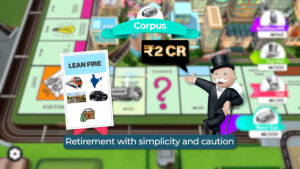
 A ₹2Cr corpus gives you a monthly budget of around ₹60,000–₹70,000, assuming a sustainable withdrawal rate of 3–4%. This is the retirement built on simplicity, caution, and careful choices.
In this version of your future, you’re likely living in a Tier-3 town or your hometown, ideally in a self-owned, debt-free home. Rent is the one expense that can quietly destroy a lean retirement, so owning the home you live in becomes essential.
Your days are slow and predictable. You cook at home more often. You know your neighbours. You walk to the local market. Travel still exists, but it’s modest — a couple of domestic trips a year, maybe a train journey to visit family, or a flight if you find a good deal. Your car is small, functional, and something you plan to use for a decade.
Healthcare becomes the biggest variable. You rely on local hospitals, and you depend heavily on insurance. As the original analysis notes, uninsured medical emergencies can derail the entire plan. This is the truth of a ₹2Cr retirement — it works, but it is fragile.
And in your later years, especially in your 70s and 80s, you will likely lean on your children for practical and emotional support. Not because you want to, but because this corpus level almost guarantees it.
This is the retirement of simplicity, but also vulnerability.
 A ₹5Cr corpus gives you a monthly budget of around ₹1.5L, and with that comes a retirement that feels balanced — not extravagant, not restricted, just comfortably in the middle.
In this future, you might live in a Tier-2 city or in a middle-class neighbourhood of a Tier-1 city if you already own property there. Life feels smoother here. You can afford household help — a maid, maybe a part-time cook — which makes daily living easier and gives you more time to enjoy the things you love.
Travel becomes a regular part of life. Domestic trips are easy to plan, and every few years, you can take a holiday to Southeast Asia or even Europe. You drive a compact SUV or a sedan, and you upgrade every 5–7 years without guilt.
Healthcare becomes more accessible. You can choose private hospitals in Tier-1 or Tier-2 cities, and you’re not constantly worried about every medical bill. Insurance still matters, but you’re not living in fear of it failing you.
This is also the first level where you can offer some support to your children — maybe helping with education, weddings, or emergencies — without destabilising your own future.
A ₹5Cr retirement is the retirement of stability. It’s the life where you don’t feel deprived, but you’re still conscious of your choices. It’s the life where you can breathe.
 A ₹10Cr corpus opens the door to a lifestyle that feels comfortable, confident, and independent. With a monthly budget of around ₹3L, you can live in a Tier-1 city without feeling squeezed by the cost of living.
In this future, you might live in a gated community — the kind with greenery, security, and amenities that make everyday life feel peaceful. You have a cook, a maid, and a driver, not because you want to “live big,” but because it gives you time and energy to focus on the things that matter.
Travel becomes a joy rather than a calculation. You can take annual trips to Europe or the US, and frequent getaways to Southeast Asia. You drive a premium SUV, and you keep a second car for convenience.
Healthcare becomes something you can choose rather than something you endure. You can afford premium hospitals, specialists, and preventive care. Assisted living or retirement communities become viable options if you ever need them.
This is also the level where supporting your children becomes meaningful — not just small help, but real contributions to their education, weddings, or even their own financial stability.
A ₹10Cr retirement is the retirement of choice. It’s the life where you feel independent, secure, and in control.
 A ₹20Cr corpus gives you a monthly budget of around ₹6.5L, and with that comes a retirement that feels effortless.
In this future, you might live in a premium gated community — the kind with landscaped gardens, clubhouses, and a sense of quiet luxury. You have full household staff: a cook, a maid, a cleaner, a driver. Life feels smooth, organised, and spacious.
Travel becomes a lifestyle rather than an event. You can take long-haul flights in business class, travel for hobbies, explore new countries, and revisit old favourites. Retirement abroad becomes a real possibility — Thailand, Malaysia, Portugal, Spain — not as a fantasy, but as a practical option.
You drive German luxury cars. You choose the best healthcare without hesitation. You can afford premium retirement communities or extensive home-based assisted care if needed.
This is also the level where you can support family generously — not just your children, but parents, siblings, and even extended family. And for the first time, philanthropy becomes a natural part of life. You have the space to think about impact, legacy, and purpose.
A ₹20Cr retirement is the retirement of abundance — not excess, but ease.
 A ₹50Cr+ corpus gives you a monthly budget of ₹15–16L, and at this level, retirement becomes something else entirely.
This is the world of ultra-luxury homes, first-class travel, top-tier healthcare, and multiple properties. You can maintain a home in a prime Indian metro, another in Goa or the hills, and even a base abroad if you choose. Your day-to-day life is fully supported by a complete household staff — a cook, multiple maids, a driver, perhaps even a house manager.
Travel becomes borderless. You can fly business or first class on long-haul routes, stay in luxury hotels, book last-minute trips, and say yes to experiences that most people only see in magazines. You can travel for months at a time without worrying about “burning through” your retirement.
Healthcare becomes a matter of absolute choice. You can access the best hospitals in India and abroad, pay out of pocket if needed, and design bespoke home-care or premium retirement living arrangements. Insurance becomes a tool, not a lifeline.
But the real shift at ₹50Cr+ is not lifestyle — it’s legacy.
You now have the capacity to fund your children’s and grandchildren’s lives in a meaningful way, create trusts, foundations, or scholarships, support causes you deeply care about, and build something that outlives you — an institution, a fund, a project, a movement.
Your conversations move from “Will my money last?” to “How do I structure this wealth so it does good, doesn’t create entitlement, and reflects my values?”
This is the retirement of impact and introspection. You have more than enough to live well.
The real work now is deciding what “well” means to you, and how much of your wealth you want to convert into meaning – for yourself, your family, and the world you leave behind.